Latest JN0-351 Exam Notes & JN0-351 Hot Spot Questions
Wiki Article
2026 Latest PrepAwayTest JN0-351 copyright and JN0-351 copyright Free Share: https://drive.google.com/open?id=1jjpw8GssHppxhoTgczjXgZTWZYi_adYf
We always adhere to the principle of “mutual development and benefit”, and we believe our JN0-351 practice materials can give you a timely and effective helping hand whenever you need in the process of learning our JN0-351 study copyright. For we have been in this career over ten years and we are good at tracing the changes of the JN0-351 guide prep in time and update our exam dumps fast and accurately.
Juniper JN0-351 Exam copyright Topics:
| Topic | Details |
|---|---|
| Topic 1 |
|
| Topic 2 |
|
| Topic 3 |
|
| Topic 4 |
|
| Topic 5 |
|
| Topic 6 |
|
>> Latest JN0-351 Exam Notes <<
Quiz JN0-351 - Efficient Latest Enterprise Routing and Switching, Specialist (JNCIS-ENT) Exam Notes
The JN0-351 practice exam we offered is designed with the real questions that will help you in enhancing your knowledge about the JN0-351 certification exam. Our online test engine will improve your ability to solve the difficulty of JN0-351 Real Questions and get used to the atmosphere of the formal test. Our experts created the valid JN0-351 study guide for most of candidates to help them get good result with less time and money.
Juniper Enterprise Routing and Switching, Specialist (JNCIS-ENT) Sample Questions (Q21-Q26):
NEW QUESTION # 21
You are asked to explore adding BGP route reflectors to allow for increased scale in your core network.
Which statement is correct in this scenario?
- A. The cluster ID is not required to use route reflectors.
- B. The cluster ID is required to prevent routing loops.
- C. Route reflectors require that the network is connected in a physical full mesh.
- D. Route reflectors are required whenever internal BGP (IBGP) sessions are needed.
Answer: B
Explanation:
A route reflector is a BGP router that is allowed to break the iBGP loop avoidance rule and advertise routes received from an iBGP peer to another iBGP peer under specific conditions 1 . A route reflector can have three types of peerings: EBGP neighbor, IBGP client neighbor, and IBGP non-client neighbor 2 . A cluster is a group of route reflectors and their clients that are fully meshed 3 . The cluster ID is a 4-byte value that identifies the route reflector cluster and is carried in the ORIGINATOR_ID attribute of the BGP update message 4 . The cluster ID is used to prevent routing loops among route reflectors and their clients. If a route reflector receives a route with its own cluster ID, it discards the route 5 . Therefore, the cluster ID is required to prevent routing loops when using route reflectors.
References:
1 : What is BGP Route Reflector - Explanation & Discussion (Cisco Example)
2 : BGP Route Reflector - NetworkLessons.com
3 : BGP Route Reflectors (RR) - Cisco Community
4 : Junos OS Routing Protocols Library for Routing Devices
5 : Junos OS Routing Protocols Library for Routing Devices
NEW QUESTION # 22
Which two BGP attributes must be supported by all BGP implementations and must be included in every update? (Choose two.)
- A. next hop
- B. AS path
- C. community
- D. MED
Answer: A,B
Explanation:
BGP attributes are properties that BGP uses for route advertisement, path selection, and loop prevention. There are four categories of BGP attributes:
Well-known mandatory: Must be recognized by all BGP routers, present in all BGP updates, and passed on to other BGP routers.
Well-known discretionary: Supported by all BGP implementations, and are optionally included in BGP updates.
Optional transitive: May not be supported by all implementations of BGP.
Optional non-transitive: May not be supported by all implementations of BGP. The well-known mandatory attributes must be supported by all BGP implementations and must be included in every update. These include the AS path and next hop attributes.
NEW QUESTION # 23
You have DHCP snooping enabled but no entries are automatically created in the snooping database for an interface on your EX Series switch. What are two reasons for the problem? (Choose two.)
- A. Dynamic ARP inspection is enabled on the interface.
- B. The device that is connected to the interface has a static IP address.
- C. MAC limiting is enabled on the interface.
- D. The device that is connected to the interface has performed a DHCPRELEASE.
Answer: B,C
Explanation:
Explanation
The DHCP snooping feature in Juniper Networks' EX Series switches works by building a binding database that maps the IP address, MAC address, lease time, binding type, VLAN number, and interface information1. This database is used to filter and validate DHCP messages from untrusted sources1.
However, there are certain conditions that could prevent entries from being automatically created in the snooping database for an interface:
MAC limiting: If MAC limiting is enabled on the interface, it could potentially interfere with the operation of DHCP snooping. MAC limiting restricts the number of MAC addresses that can be learned on a physical interface to prevent MAC flooding attacks1. This could inadvertently limit the number of DHCP clients that can be learned on an interface, thus preventing new entries from being added to the DHCP snooping database.
Static IP address: If the device connected to the interface is configured with a static IP address, it will not go through the DHCP process and therefore will not have an entry in the DHCP snooping database1. The DHCP snooping feature relies on monitoring DHCP messages to build its database1, so devices with static IP addresses that do not send DHCP messages will not have their information added.
Therefore, options B and C are correct. Options A and D are not correct because performing a DHCPRELEASE would simply remove an existing entry from the database1, and Dynamic ARP inspection (DAI) uses the information stored in the DHCP snooping binding database but does not prevent entries from being created1.
NEW QUESTION # 24
Which two statements are true about the default VLAN on Juniper switches? (Choose two.)
- A. The default VLAN ID is not visible.
- B. The default VLAN ID is not assigned to any interface.
- C. The default VLAN ID can be changed.
- D. The default VLAN is set to a VLAN ID of 1 by default
Answer: C,D
Explanation:
On Juniper switches, the default VLAN is set to a VLAN ID of 1 by default 1 2 . This means that all interfaces on the switch are members of VLAN 1 until they are specifically assigned to another VLAN 1 2 .
Therefore, option A is correct.
The default VLAN ID can be changed 1 2 . This allows network administrators to configure the switch to use a different VLAN as the default, if necessary 1 2 . Therefore, option D is correct.
NEW QUESTION # 25
Exhibit.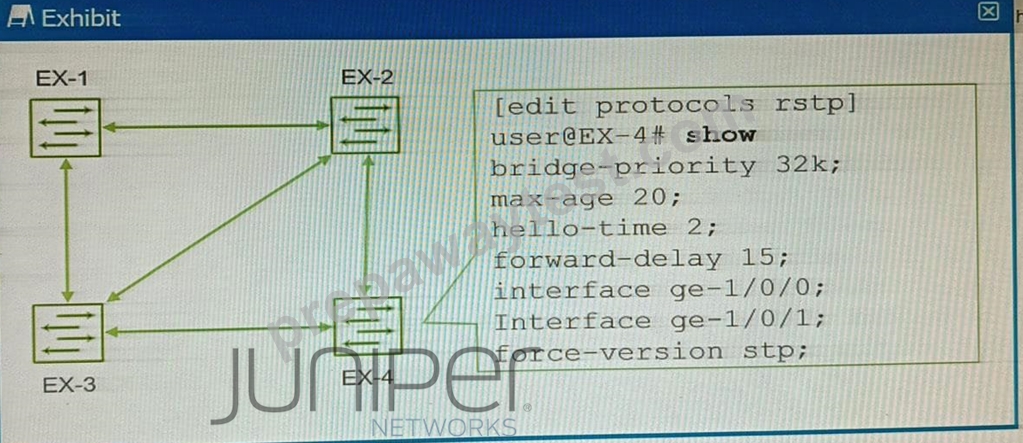
You have configured the four EX Series switches with RSTP, as shown in the exhibit. You discover that whenever a link between switches goes up or down, the switches take longer than expected for RSTP to converge, using the default settings.
In this scenario, which action would solve the delay in RSTP convergence?
- A. The hello-time must be increased.
- B. The bridge priority for EX-4 must be set at 4000.
- C. The max-age must be increased to 20
- D. The force-version must be removed.
Answer: D
Explanation:
The exhibit shows the configuration of RSTP on EX-4, which has the command force-version stp. This command forces the switch to use the legacy STP protocol instead of RSTP, even though the switch supports RSTP1. This means that EX-4 will not be able to take advantage of the faster convergence and enhanced features of RSTP, such as edge ports, link type, and proposal/agreement sequence2.
The other switches in the network are likely to be running RSTP, as it is the default protocol for EX Series switches3. Therefore, there will be a compatibility issue between EX-4 and the other switches, which will result in longer convergence times and suboptimal performance. The switch will also generate a warning message that says "Warning: STP version mismatch with neighbor" when it receives a BPDU from a RSTP neighbor1.
To solve this problem, the force-version command must be removed from EX-4, so that it can run RSTP natively and interoperate with the other switches in the network. This will enable faster convergence and better stability for the network topology. To remove the command, you can use the delete protocols rstp force-version command in configuration mode1.
NEW QUESTION # 26
......
It results in JN0-351 exam failure and loss of time and money. To pass the Juniper JN0-351 exam in a short time, you must prepare with updated Juniper JN0-351 practice questions. However, the PrepAwayTest is one of the best and most dependable. This platform offers updated and Real JN0-351 Exam Questions that help applicants ace the JN0-351 test for the first time.
JN0-351 Hot Spot Questions: https://www.prepawaytest.com/Juniper/JN0-351-practice-exam-dumps.html
- JN0-351 Test Questions Answers ???? JN0-351 Pass Guarantee ???? JN0-351 Test Dumps Free ???? Open ⇛ www.prepawayete.com ⇚ and search for ➥ JN0-351 ???? to download exam materials for free ????Free JN0-351 Exam
- Free PDF Quiz Juniper - JN0-351 - Enterprise Routing and Switching, Specialist (JNCIS-ENT) –Professional Latest Exam Notes ???? Open ( www.pdfvce.com ) and search for ➤ JN0-351 ⮘ to download exam materials for free ????JN0-351 Trusted Exam Resource
- Latest Online Juniper JN0-351 Practice Tests ???? Immediately open ( www.prepawayete.com ) and search for ▷ JN0-351 ◁ to obtain a free download ????JN0-351 Exam Assessment
- Exam JN0-351 Objectives ???? New JN0-351 Exam Practice ???? Latest JN0-351 Examprep ❎ Open website “ www.pdfvce.com ” and search for ▶ JN0-351 ◀ for free download ????JN0-351 New copyright Pdf
- Online JN0-351 Lab Simulation ???? JN0-351 Exam Assessment ???? Exam JN0-351 Forum ???? Search on ▛ www.pdfdumps.com ▟ for ✔ JN0-351 ️✔️ to obtain exam materials for free download ⛅Related JN0-351 Exams
- Juniper Latest JN0-351 Exam Notes: Enterprise Routing and Switching, Specialist (JNCIS-ENT) - Pdfvce Pass Guaranteed ???? Search for “ JN0-351 ” on ▶ www.pdfvce.com ◀ immediately to obtain a free download ????JN0-351 Exam Objectives
- Pass Guaranteed The Best JN0-351 - Latest Enterprise Routing and Switching, Specialist (JNCIS-ENT) Exam Notes ???? Easily obtain free download of “ JN0-351 ” by searching on ➤ www.practicevce.com ⮘ ????Online JN0-351 Lab Simulation
- 100% Pass Juniper - JN0-351 –Reliable Latest Exam Notes ???? Search for 「 JN0-351 」 and download it for free immediately on ✔ www.pdfvce.com ️✔️ ????Free JN0-351 Exam
- Free PDF Quiz Juniper - JN0-351 - Enterprise Routing and Switching, Specialist (JNCIS-ENT) –Professional Latest Exam Notes ???? Simply search for ☀ JN0-351 ️☀️ for free download on ✔ www.prepawayete.com ️✔️ ????JN0-351 Pass Guarantee
- Exam JN0-351 Cram Ⓜ JN0-351 Trusted Exam Resource ???? Free JN0-351 Exam ???? Open ➥ www.pdfvce.com ???? and search for 《 JN0-351 》 to download exam materials for free ????JN0-351 Exam Assessment
- Trustable Latest JN0-351 Exam Notes - Leading Offer in Qualification Exams - Latest updated JN0-351: Enterprise Routing and Switching, Specialist (JNCIS-ENT) ???? Search for 《 JN0-351 》 and download exam materials for free through ➽ www.troytecdumps.com ???? ????Exam JN0-351 Objectives
- brontekiah638010.losblogos.com, zaynbxmh918286.onzeblog.com, montyogkg166729.dailyblogzz.com, lawsonqzwu120252.snack-blog.com, jakubajgq790532.liberty-blog.com, blanchegwcy063196.wikimidpoint.com, deannayiat548755.blogthisbiz.com, easiestbookmarks.com, bookmarkassist.com, www.stes.tyc.edu.tw, Disposable vapes
DOWNLOAD the newest PrepAwayTest JN0-351 copyright from Cloud Storage for free: https://drive.google.com/open?id=1jjpw8GssHppxhoTgczjXgZTWZYi_adYf
Report this wiki page